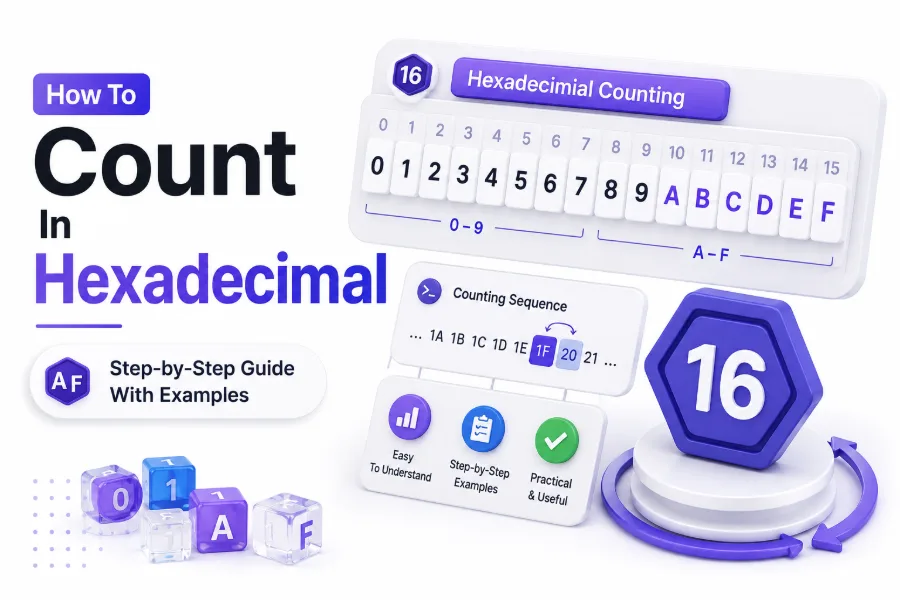
Counting in hexadecimal is similar to counting in the decimal system, but there is one important difference: hexadecimal uses 16 symbols instead of 10. After the digits 0 through 9, hexadecimal continues with A, B, C, D, E, and F. Once you know what these letters represent, the counting pattern becomes much easier to follow.
The hexadecimal system is called base 16 because each position represents a power of 16. Decimal counting resets after 9, while hexadecimal resets after F. For example, after 8 comes 9, after 9 comes A, and after F comes 10. That 10 is hexadecimal, not decimal ten.
Knowing how to count in hexadecimal is useful when working with programming, computer memory, binary data, color codes, hex editors, and other technical systems. The process becomes straightforward when you learn the basic digit sequence and understand what happens when a position reaches its maximum value.
The Basic Hexadecimal Counting Sequence
Hexadecimal uses 16 symbols to represent values from zero through fifteen. The first ten symbols are familiar decimal digits, while the final six values use letters. The sequence starts with 0, 1, 2, 3, 4, 5, 6, 7, 8, and 9, followed by A, B, C, D, E, and F.
The letters have numerical values. A represents 10, B represents 11, C represents 12, D represents 13, E represents 14, and F represents 15. These are still numerical values, even though letters are used as their symbols.
Hexadecimal Digits From 0 to F
The complete single-digit sequence is:
- 0 = 0
- 1 = 1
- 2 = 2
- 3 = 3
- 4 = 4
- 5 = 5
- 6 = 6
- 7 = 7
- 8 = 8
- 9 = 9
- A = 10
- B = 11
- C = 12
- D = 13
- E = 14
- F = 15
Once you reach F, there are no more single hexadecimal digits. The next value requires two positions, so the count moves to 10. This works just like decimal moving from 9 to 10, except hexadecimal rolls over after 15 instead of 9.
How Hexadecimal Counting Differs From Decimal
The main difference between decimal and hexadecimal counting is the number of available digits. Decimal is base 10, so each position can contain a value from 0 through 9. Hexadecimal is base 16, so each position can contain a value from 0 through F.
This means hexadecimal counts through six additional values before moving to the next position. In decimal, the sequence goes 8, 9, 10. In hexadecimal, the equivalent pattern is 8, 9, A, B, C, D, E, F, 10.
Decimal and Hexadecimal Side by Side
| Decimal | Hexadecimal |
|---|---|
| 0 | 0 |
| 1 | 1 |
| 2 | 2 |
| 3 | 3 |
| 4 | 4 |
| 5 | 5 |
| 6 | 6 |
| 7 | 7 |
| 8 | 8 |
| 9 | 9 |
| 10 | A |
| 11 | B |
| 12 | C |
| 13 | D |
| 14 | E |
| 15 | F |
| 16 | 10 |
| 17 | 11 |
| 18 | 12 |
| 19 | 13 |
| 20 | 14 |
The important point is that hexadecimal 10 represents decimal 16, not decimal 10. The first digit represents one group of 16, while the second digit represents zero additional units.
What Happens After F
When a hexadecimal count reaches F, the next count is 10. The rightmost position resets to zero, and the position on its left increases by one. This is the same carrying process used in ordinary decimal counting.
For example, after 1F comes 20. The F has reached its maximum value, so it resets to 0 and the 1 increases to 2. After 2F comes 30, and after FF comes 100.
The Carrying Pattern
The pattern becomes easier to see when several transitions are listed:
- 09 → 0A
- 0A → 0B
- 0E → 0F
- 0F → 10
- 19 → 1A
- 1F → 20
- 2F → 30
- 9F → A0
- AF → B0
- FF → 100
The rule is always the same. Whenever a digit would move beyond F, it resets to 0 and carries 1 into the next position.
Key counting rules:
- Hexadecimal has 16 possible values per position.
- A through F represent 10 through 15.
- After F comes 10.
- After 1F comes 20.
- After FF comes 100.
- Each new position represents a power of 16.
Understanding Hexadecimal Place Values
Hexadecimal counting becomes much clearer when you understand place values. In decimal, positions represent powers of 10. In hexadecimal, positions represent powers of 16.
The rightmost position represents 16⁰, which equals 1. The next position represents 16¹, which equals 16. The next represents 16², which equals 256. Each position is therefore sixteen times larger than the position immediately to its right.
Hexadecimal Place Values
For a three-digit hexadecimal number, the positions are:
| Position | Power | Decimal Value |
|---|---|---|
| First from right | 16⁰ | 1 |
| Second from right | 16¹ | 16 |
| Third from right | 16² | 256 |
| Fourth from right | 16³ | 4,096 |
For example, the hexadecimal number 123 is calculated as 1 × 256, plus 2 × 16, plus 3 × 1. That gives a decimal value of 291. The same place-value principle applies to every hexadecimal number.
Counting From 00 to FF
A very common hexadecimal range is 00 through FF. This range contains every possible value that can be represented by one byte, which contains eight bits.
The count begins with 00, then 01, 02, and continues through 09. After 09, it moves to 0A, eventually reaching 0F. The next value is 10, and the process continues until FF.
Common Hexadecimal Counting Milestones
Here are some useful points in the sequence:
- 00 = decimal 0
- 01 = decimal 1
- 09 = decimal 9
- 0A = decimal 10
- 0F = decimal 15
- 10 = decimal 16
- 1F = decimal 31
- 20 = decimal 32
- 40 = decimal 64
- 80 = decimal 128
- FF = decimal 255
This range appears frequently in programming, color values, file formats, and computer memory because a byte can store 256 different values, from 0 through 255.
How to Count in Hexadecimal Step by Step
The easiest way to count in hexadecimal is to start with the familiar decimal digits and then introduce the letters. Count from 0 through 9 normally. Instead of stopping, continue with A through F.
After F, return the rightmost digit to 0 and increase the digit immediately to its left. This produces 10. Continue increasing the rightmost digit through F again, then carry to the left whenever necessary.
A Simple Counting Exercise
Suppose you want to count from hexadecimal 18 onward. The sequence is:
18, 19, 1A, 1B, 1C, 1D, 1E, 1F, 20
Notice that only the rightmost digit changes until it reaches F. Once F is reached, the next count resets that digit to 0 and increases the left digit from 1 to 2.
This is exactly the same principle as decimal counting. The only difference is that hexadecimal has sixteen values available in each position instead of ten.
Counting in Hexadecimal Using Binary
Hexadecimal is closely connected to binary because one hexadecimal digit represents exactly four binary bits. This relationship can help explain why hexadecimal counting works the way it does.
For example, hexadecimal 0 corresponds to binary 0000, while hexadecimal F corresponds to binary 1111. When the hexadecimal count moves from F to 10, the binary representation moves from 1111 to 1 0000.
Hexadecimal and Binary Counting
The relationship looks like this:
| Hex | Binary |
|---|---|
| 0 | 0000 |
| 1 | 0001 |
| 2 | 0010 |
| 3 | 0011 |
| 4 | 0100 |
| 5 | 0101 |
| 6 | 0110 |
| 7 | 0111 |
| 8 | 1000 |
| 9 | 1001 |
| A | 1010 |
| B | 1011 |
| C | 1100 |
| D | 1101 |
| E | 1110 |
| F | 1111 |
This direct relationship makes hexadecimal useful for representing binary information in a compact form. It also makes it easier to recognize individual groups of bits.
Counting Beyond FF
After hexadecimal FF, the next value is 100. This may look surprising at first, but it follows the same carrying rule used throughout the system.
The rightmost F becomes 0, the middle F also becomes 0 after carrying, and the new leftmost position becomes 1. Since the third position represents 256 in decimal, hexadecimal 100 equals decimal 256.
Examples After FF
The sequence around this transition is:
- FC
- FD
- FE
- FF
- 100
- 101
- 102
- 103
- 104
- 105
The same pattern continues indefinitely. After 10F comes 110, after 1FF comes 200, and after FFF comes 1000.
Useful hexadecimal transitions:
- 09 → 0A
- 0F → 10
- 19 → 1A
- 1F → 20
- 2F → 30
- 9F → A0
- AF → B0
- FF → 100
- 1FF → 200
- FFF → 1000
How to Count in Hexadecimal With Larger Numbers
Larger hexadecimal numbers follow exactly the same rules as smaller ones. Every position can contain one of sixteen values, and reaching F causes a carry into the next position.
For example, consider 2A7. The rightmost position changes from 0 through F before the middle position increases. When the middle position reaches F, the next count carries into the leftmost position.
Reading Larger Hexadecimal Values
A hexadecimal number does not need to be converted to decimal before you can count with it. You can simply apply the base-16 counting rules directly.
For example:
2A8, 2A9, 2AA, 2AB, 2AC
Here, the transition from 9 to A happens in the rightmost position. Later, when the rightmost position reaches F, the carry moves to the middle position.
If you are working with long values, a [hexadecimal converter](Internal Link: Hexadecimal Converter) can also help verify your calculations and reduce manual errors.
Common Mistakes When Counting in Hexadecimal
One common mistake is assuming that A through F are separate from the numerical sequence. They are not. They are simply the symbols for values 10 through 15.
Another mistake is assuming that hexadecimal 10 means decimal 10. It does not. In hexadecimal, the 1 represents one group of sixteen, so 10 equals decimal 16.
Mistakes to Avoid
Keep these points in mind:
- Do not stop at 9.
- Remember A = 10 and F = 15.
- Do not treat hexadecimal 10 as decimal 10.
- Carry when a digit passes F.
- Remember that each position is based on powers of 16.
- Use leading zeros when fixed-width values are required.
- Check whether a value is hexadecimal before converting it.
These simple rules prevent most beginner errors. With a little practice, hexadecimal counting becomes as predictable as decimal counting.
Practical Uses of Hexadecimal Counting
Hexadecimal counting is not just a mathematical exercise. It appears in real computer systems because hexadecimal maps efficiently to binary and bytes. Developers may encounter hexadecimal sequences when examining memory, debugging software, working with network data, or analyzing files.
Web developers also see hexadecimal when working with color codes. A six-digit color such as #336699 contains three two-digit hexadecimal values, one for each red, green, and blue channel.
Where You May See Hexadecimal
Common examples include:
- Memory addresses.
- HTML and CSS color codes.
- Hex editors.
- Programming languages.
- Debugging tools.
- Binary file analysis.
- Network protocols.
- Embedded systems.
- Bitwise operations.
- Character encoding.
The more you work with technical data, the more natural hexadecimal counting becomes. Recognizing patterns such as 0F, 10, FF, and 100 can save time when reading computer-generated values.
Tips for Learning Hexadecimal Counting
Practice is more effective when you focus on the transitions that initially seem unusual. Spend time counting through 9 to A, E to F, F to 10, and FF to 100. These are the points where hexadecimal differs most visibly from decimal.
It also helps to practice with both single-digit and multi-digit values. Once you can quickly recognize A through F and understand the carrying process, larger hexadecimal sequences become much easier to follow.
A Simple Practice Method
Try writing short sequences without converting them to decimal:
- 7, 8, 9, A, B, C
- C, D, E, F, 10
- 1C, 1D, 1E, 1F, 20
- 2E, 2F, 30, 31, 32
- FC, FD, FE, FF, 100
After practicing these patterns, try creating your own sequences and checking whether the carrying works correctly.
Conclusion
Learning how to count in hexadecimal is mainly a matter of becoming comfortable with sixteen symbols instead of ten. The sequence starts with 0 through 9, continues with A through F, and then carries into a new position. Once F is reached, the next value is 10, just as decimal moves to a new position after 9.
The place-value system explains everything that follows. Each position represents a power of 16, and every hexadecimal digit corresponds to four binary bits. This makes hexadecimal particularly useful for representing bytes, memory addresses, color values, and other computer data in a compact form.
The most important patterns to remember are 9 to A, F to 10, 1F to 20, and FF to 100. With these transitions firmly in mind, counting becomes predictable. Regular practice with short sequences and hexadecimal-to-decimal comparisons will make the system much easier to read and use in programming and everyday technical tasks.
Frequently Asked Questions
What comes after 9 in hexadecimal?
After 9 comes A. In hexadecimal, A represents decimal 10. The sequence continues with B, C, D, E, and F before moving to 10.
What comes after F in hexadecimal?
After F comes 10. Hexadecimal F represents decimal 15, so the next value carries into a second position. Hexadecimal 10 therefore represents decimal 16.
What does FF mean in hexadecimal?
FF is a two-digit hexadecimal value in which both digits have their maximum value of 15. It equals decimal 255 and represents the largest unsigned value that fits in one byte.
How many digits does hexadecimal use?
Hexadecimal uses 16 symbols: the numbers 0 through 9 and the letters A through F. Each symbol represents one value from 0 through 15.
Is hexadecimal counting the same as decimal counting?
The basic counting principle is the same, but hexadecimal uses base 16 instead of base 10. Each position has sixteen possible values, so counting continues through A–F before carrying to the next position.
0 Comments